
Money & Budget
Cash, Cards & ATMs in Thailand: What Travelers Should Know
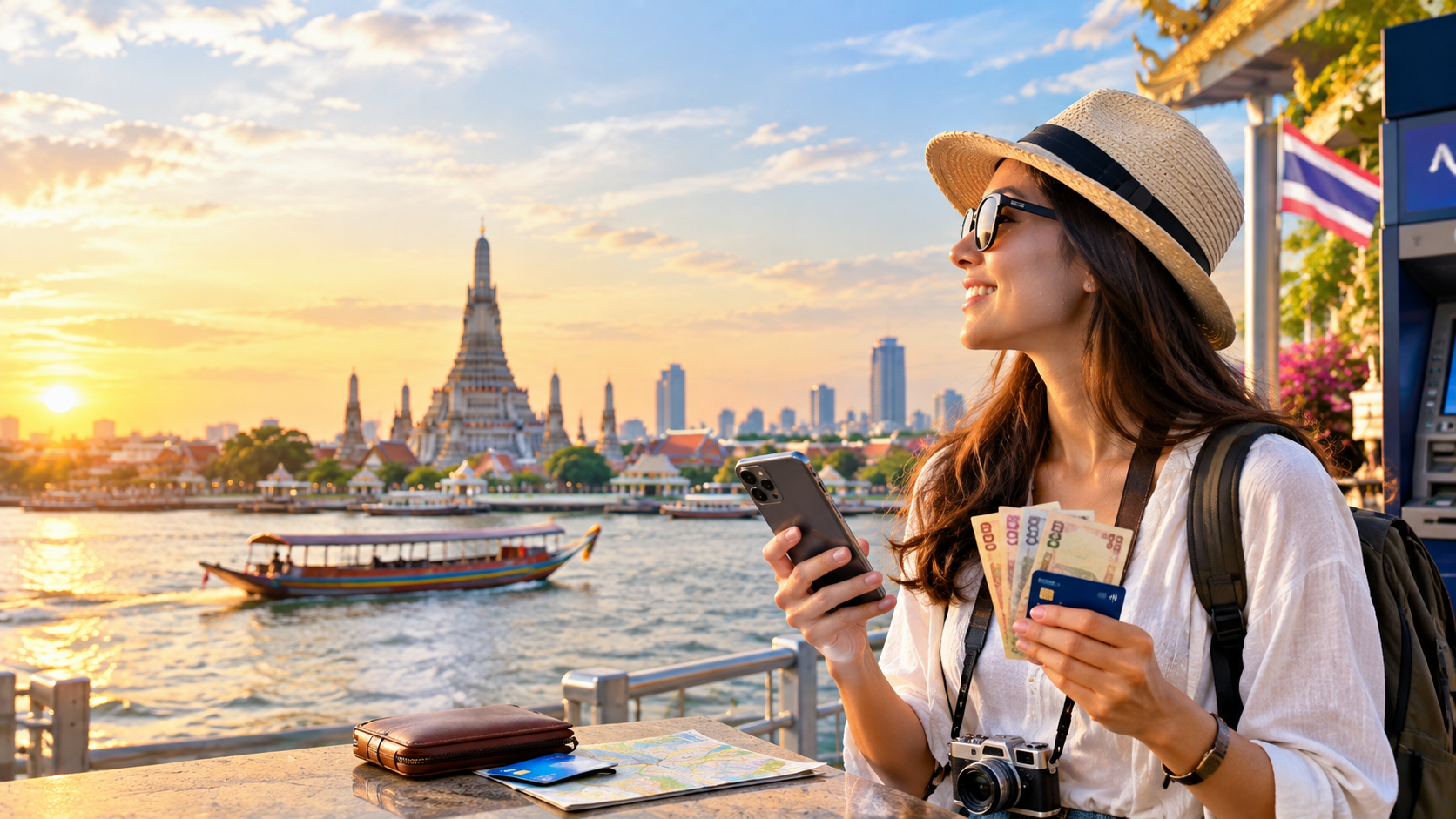
Thailand is increasingly convenient for cashless payments, especially in Bangkok and other major tourist destinations. However, cash remains an important part of daily life, particularly at local markets, street-food stalls, small shops, taxis, and some smaller businesses. The smartest approach for most travelers is simple: carry some Thai baht, keep a card available, and know where you can safely get more cash or exchange currency when needed.
1. Thailand's Currency: The Thai Baht
Thailand's official currency is the Thai baht (THB), commonly written as ฿ or THB. Banknotes come in several denominations, while coins are commonly used for smaller purchases, transportation, convenience stores, and other everyday expenses. It is useful to keep a mixture of smaller banknotes and coins with you. Having smaller denominations can make paying at local markets, food stalls, taxis, and small shops much easier. Travel Tip: Don't rely on having only large banknotes. Breaking a ฿1,000 note may not always be convenient for a small purchase.
2. Should You Carry Cash in Thailand?
Yes — even if you normally prefer using cards. Credit and debit cards are widely accepted in hotels, shopping malls, department stores, restaurants, international chains, and many established businesses. However, cash can still be essential for:
- Street food and local markets
- Small restaurants and neighborhood shops
- Taxis and some local transportation
- Small attractions and vendors
- Tips and small purchases
- Rural areas and smaller towns
- Businesses that have a minimum card-payment amount
A good strategy is to carry enough cash for the day's activities while keeping additional funds safely stored elsewhere.
Don't carry all your travel money in one place.
3. Using Credit and Debit Cards in Thailand
Visa and Mastercard are generally convenient options for travelers, particularly in tourist areas and larger businesses.
Before traveling, check with your bank or card issuer about:
- Foreign transaction fees
- International ATM withdrawal fees
- Daily withdrawal limits
- Card security settings
- Whether your card requires travel notification
- How your bank handles overseas transactions
It is also a good idea to have more than one payment option. If one card is lost, blocked, or declined, having a backup card can save you a lot of trouble.
A USEFUL CARD PAYMENT RULE
When a payment terminal asks whether you want to pay in your home currency or Thai baht, you will often want to consider choosing Thai baht (THB) rather than accepting an automatically converted amount.
This can help you avoid Dynamic Currency Conversion (DCC), where the merchant or payment provider converts the transaction into your home currency at its own exchange rate.
Always review the amount and currency shown on the terminal before confirming the transaction.
4. Using ATMs in Thailand
ATMs are widely available throughout Thailand, especially in Bangkok, Chiang Mai, Phuket, Pattaya, and other major tourist destinations. The Bank of Thailand reports that Bangkok alone accounted for more than 11,000 ATMs in 2024, with substantial ATM coverage also found in other major tourist provinces. You can find ATMs at:
- Banks
- Shopping malls
- Convenience stores
- Airports
- BTS and MRT areas
- Tourist districts
- Major transportation hubs
Travel Tip: Consider making fewer, appropriately sized ATM withdrawals rather than repeatedly withdrawing very small amounts, since fees can apply to individual transactions.
Before using an ATM, Check:
1. Your bank's international withdrawal fee
2. The Thai ATM's displayed fee
3. Your daily withdrawal limit
4. The exchange-rate option offered by the ATM
If an ATM offers to convert the withdrawal into your home currency, carefully review the screen before accepting.
You may prefer to have your own bank or card network handle the currency conversion instead.
Keep your ATM receipts Receipts can be useful for tracking your spending and resolving a transaction problem if something goes wrong.
5. Currency Exchange in Thailand
There are several ways to obtain Thai baht, including:
- Exchanging foreign cash at a licensed currency-exchange provider
- Withdrawing Thai baht from an ATM
- Using your debit or credit card for purchases
- Exchanging money through a bank
Recommended Currency Exchange: SuperRich 1965 For travelers looking for an established currency-exchange provider in Thailand, SuperRich Currency Exchange (1965) is one option worth considering. Established in 1965, SuperRich Currency Exchange (1965) — also known as SuperRich Orange — has more than 60 years of experience and operates a network of branches in key areas of Bangkok.
If you arrive with foreign cash, compare the exchange rate before making a large transaction. Don't exchange everything at the airport Airport exchange counters can be convenient when you first arrive, especially if you need a small amount of Thai baht for transportation or immediate expenses. However, travelers who need to exchange a larger amount may want to compare rates with established exchange providers in the city. A few minutes of rate comparison can make a difference when exchanging a substantial amount of money.